

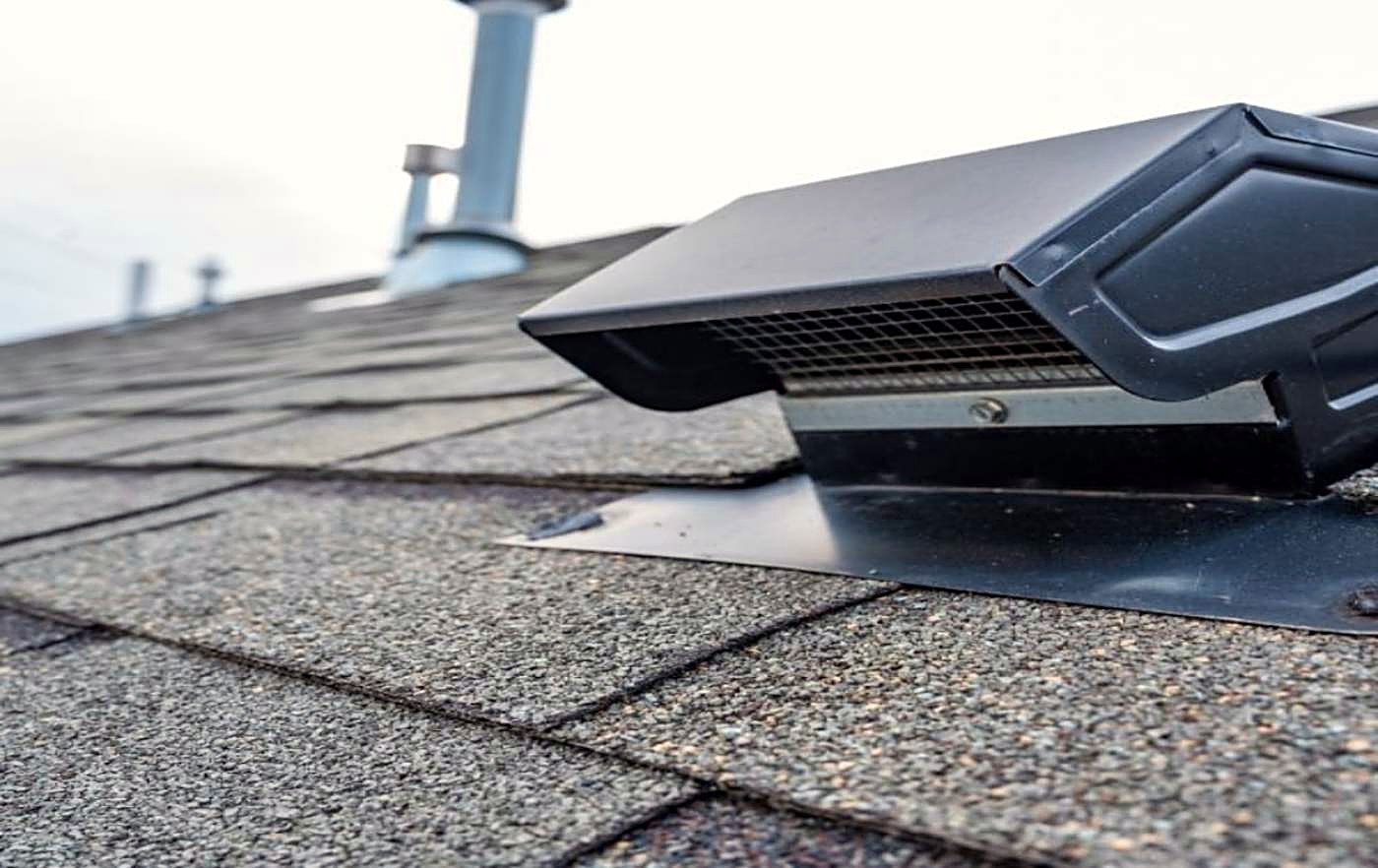
Does attic ventilation affect how long a roof lasts?
Yes. A poorly ventilated attic in North Texas can pass 140°F on a summer afternoon, and that heat bakes shingles from underneath, drying the asphalt out so it curls and sheds granules years early. Good ventilation draws cooler air in low at the soffits and lets hot air out high near the ridge. Shingle manufacturers write ventilation requirements into their warranties, so a poorly vented attic can also weaken the warranty on a new roof.
Shingles cook from both sides in a Texas summer
On a July afternoon in Dallas-Fort Worth the top of a dark shingle roof can reach 150°F to 170°F. With good airflow underneath, the decking gives some of that heat off into a moving stream of air. In an attic with poor ventilation the air stays trapped and can climb well past 140°F, so the shingle is heated from above and below at once.
Asphalt shingles age through heat. The oils that keep them flexible bake out, and the shingle turns brittle, curls at the edges and lets go of its granules. A roof over a hot attic can look ten years older than the same roof over a well-vented one.
The house pays for it too. Heat soaks through the ceiling into upstairs rooms, and in the many DFW homes with air conditioning equipment in the attic, the AC is pushing cold air through the hottest space on the property.
Code calls for one square foot of vent per 150 square feet of attic
The International Residential Code, which DFW cities adopt with their own amendments, sets a minimum net free vent area of 1 square foot for every 150 square feet of attic floor. That drops to 1 in 300 when the vents are balanced, with roughly 40% to 50% of the area up high near the ridge and the rest low at the eaves.
For an 1,800-square-foot attic that works out to 12 square feet of net free area at the 1-in-150 ratio, or 6 square feet at the balanced 1-in-300 ratio, split between intake and exhaust.
Net free area is smaller than the size of the vent, because louvers and screens block some of the opening. The rated figure is printed on the product or its packaging.
Mixing vent types can make an attic hotter
Air should enter at the soffits, sweep up the underside of the decking, and leave at the ridge. Putting different exhaust vents on the same roof, such as a ridge vent alongside turtle vents, gable vents or a powered fan, lets one exhaust pull air in through the other. The attic ventilates itself in a short loop near the top, and the lower decking stays hot.
Powered attic fans carry a second problem. When there is not enough intake, a fan pulls air from wherever it can, including conditioned air from the house through ceiling lights and the attic hatch. In homes with gas appliances vented through the attic, that negative pressure can draw exhaust gases back down the flue.
Intake is the half that most often goes missing. Many DFW homes from the 1970s and 1980s were built with few soffit vents, and in others, blown insulation has buried the ones that exist. Foam or cardboard baffles between the rafters keep a channel open above the insulation.
A hot attic shows on the roof and inside the house
On the roof, look for shingles that curl, blister or lose granules faster on some slopes than others, and for decking that feels spongy. In the attic, look for rusted nail tips poking through the decking, dark staining on the wood, and insulation packed hard against the eaves.
Inside, the signs are upstairs rooms that never cool down and summer electric bills that keep climbing. During a winter cold snap, frost or water drips on nails in the attic mean warm, moist air from the house is condensing there.
A reroof is the cheapest time to correct ventilation, because the decking is already exposed. A ridge vent can be cut in, mismatched vents removed and intake added in the same job.
Related questions
Should I add a solar or powered attic fan?
Only with enough intake to feed it, and ideally not alongside a ridge vent. A fan without enough soffit intake pulls conditioned air out of the house, and it can pull exhaust gases from attic gas appliances back down their flues.
How can I tell if my soffit vents are blocked?
On a sunny day, look along the eaves from inside the attic. If you cannot see daylight through the soffit vents, or insulation is packed against the underside of the roof deck, the intake is blocked.
Does a radiant barrier replace attic ventilation?
No. A radiant barrier reduces the heat radiating from the roof deck into the attic, and ventilation carries hot air out. They do different jobs and work well together in Texas attics.